



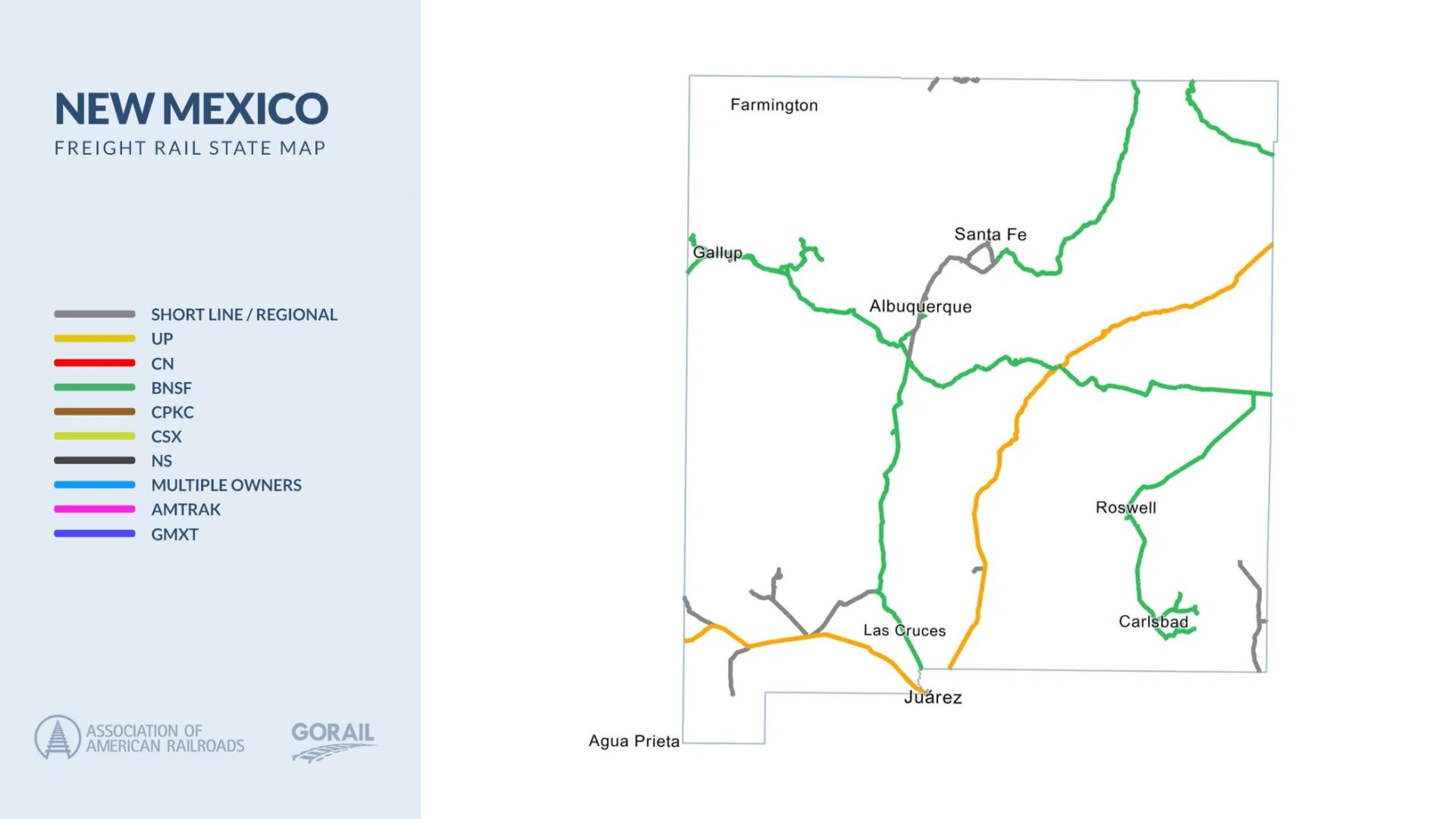
State Rail Network


Class I Railroads

BNSF Railway 1,636
Union Pacific 618
Total 2,254

Short Line Railroads

Arizona Eastern Railway 50
Santa Teresa Southern Railroad 2
Southwestern Railroad 102
Texas & New Mexico Railway 70
Total 224
2022 Source: Association of American Railroads (AAR). Data represents most recent available annual reporting. AAR Logo

Moving New Mexico's Economy. Connecting Communities.


Railroads have a played a substantial role in the Land of Enchantment economy since the first tracks arrived in the New Mexico Territory in 1879.

Originating

Top Commodities Originating
Coal 3.2M Tons | 26.5K Cars
Chemicals 0.9M Tons | 9.2K Cars
Intermodal 0.7M Tons | 62.1K Cars
Petroleum Products 0.5M Tons | 5.6K Cars
Waste & Scrap 0.4M Tons | 3.9K Cars
Other 1.1M Tons | 16.3K Cars

Received

Top Commodities Received / Terminated
Food Products 1.4M Tons | 13.6K Cars
Chemicals 0.9M Tons | 9K Cars
Intermodal 0.6M Tons | 53.3K Cars
Grain 0.6M Tons | 5.8K Cars
Petroleum Products 0.4M Tons | 5.1K Cars
Other 2.3M Tons | 32.6K Cars
NEW MEXICO'S

State Grants


New Mexico Section 130 Highway-Rail Safety Improvement Program

Rail

Join the movement in support of freight rail in your state and across North America.

Why Freight Rail Matters


Supports Manufacturing Icon

Supports Manufacturing

Rail connects manufacturers with suppliers and customers across North America, efficiently moving raw materials and finished goods.

Strengthens Agriculture Icon

Strengthens Agriculture

Rail helps move crops, forest products, fertilizers and other agricultural goods efficiently and affordably.

Reduces Congestion Icon

Reduces Congestion

Moving freight by rail removes trucks from highways, helping reduce traffic and wear on road infrastructure.

Protects the Environment Icon

Protects the Environment

Freight rail is significantly more fuel efficient than moving freight by truck, helping reduce fuel use and greenhouse gas emissions.

Rail at Work


See All

Featured Rail Supply Companies


See All

icon_railfreight

44 percent
decrease

in rail rates on average from 1981 to today.


That means the average rail customer today can ship significantly more freight for about the same price they paid 40 years ago.