




State Rail Network
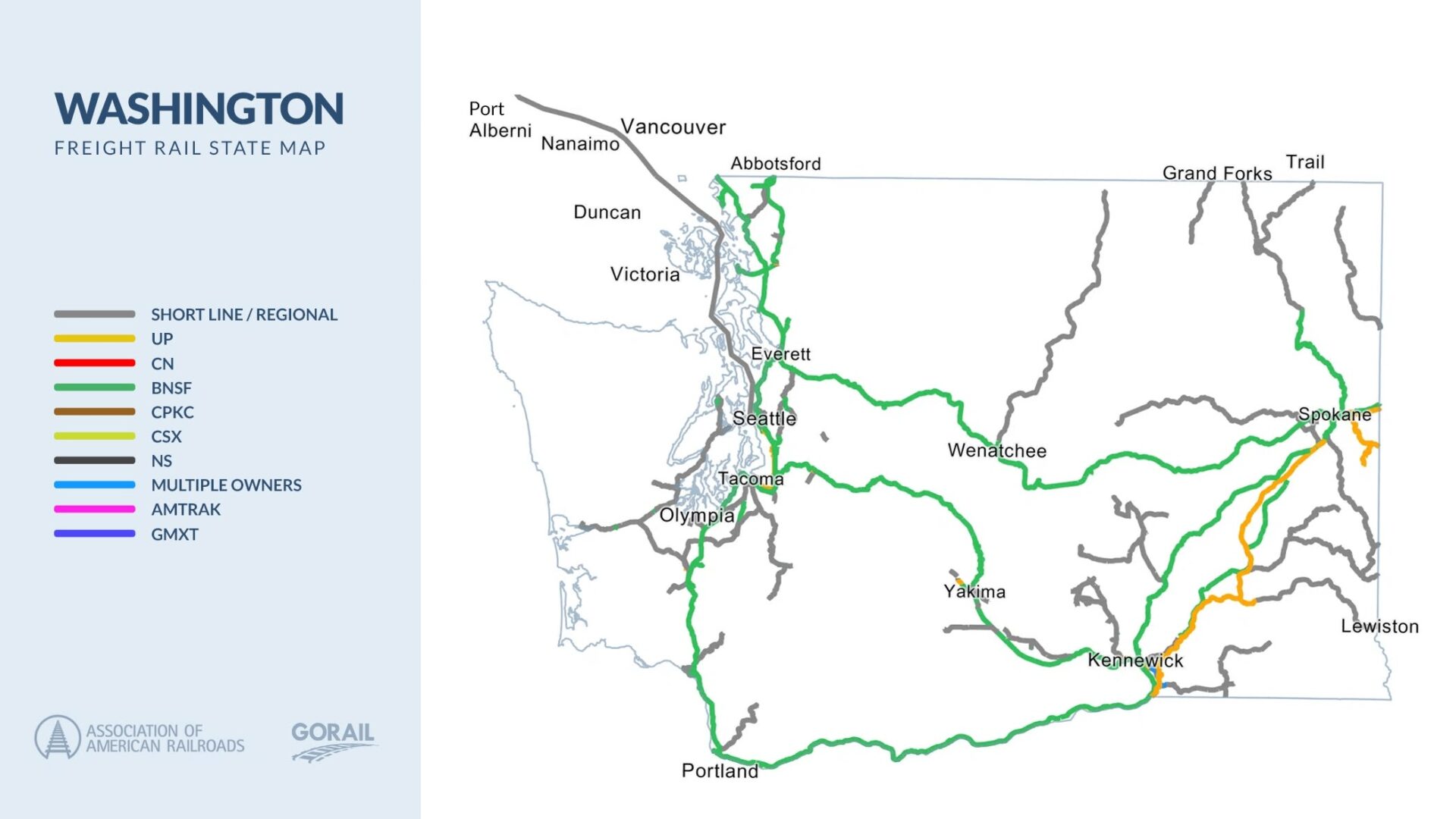
Class I Railroads
| BNSF Railway | 1,450 |
| Union Pacific | 540 |
| Total | 1,990 |
Short Line Railroads
| Ballard Terminal Railroad | 2 |
| Cascade & Columbia River Railroad | 154 |
| Central Washington Railroad | 80 |
| Columbia & Cowlitz Railway | 9 |
| Columbia and Walla Walla Railway | 82 |
| Total | 1,352 |

Moving Washington's Economy. Connecting Communities.
More than twice as export-intensive as the average U.S. state, Washington and its manufacturers, farms and communities rely on freight rail to move commodities and products from inland locations to seaports.
Originating
Received
State Grants
Freight Rail Assistance Program (FRAP)
Freight Rail Investment Bank (FRIB)
Rail Heritage
Seattle lost the railroad, so it built its own. When the Northern Pacific Railroad chose Tacoma over Seattle as its western terminus in July 1873, Seattle’s leaders responded by building their own rail connections rather than waiting on the transcontinental line, a rivalry that shaped the state’s development for decades. The Northern Pacific’s own route, delayed for years by the Panic of 1873, was finally completed in 1883 under financier Henry Villard. Seattle’s King Street Station opened in 1906, built jointly by the Northern Pacific and Great Northern railways, cementing the city’s place on the national rail map after all. That competition between rival lines and rival cities built the dense rail network Washington’s ports and industries still rely on today.

Why Freight Rail Matters

Supports Manufacturing
Rail connects manufacturers with suppliers and customers across North America, efficiently moving raw materials and finished goods.

Strengthens Agriculture
Rail helps move crops, forest products, fertilizers and other agricultural goods efficiently and affordably.

Reduces Congestion
Moving freight by rail removes trucks from highways, helping reduce traffic and wear on road infrastructure.

Protects the Environment
Freight rail is significantly more fuel efficient than moving freight by truck, helping reduce fuel use and greenhouse gas emissions.
Rail at Work
 Safety
 FRA Data Shows Major Rail Safety Gains in 2025
Washington, D.C. – New data from the Federal Railroad Administration (FRA) shows 2025 was a historic year for freight rail safety. Accident and injury rates…
 Policy Issues
 Rail Policy Landscape in the 117th Congress
Washington, D.C. — As the 117th Congress dives into its work—and committee assignments and leadership roles have been finalized—we now know more about the key…
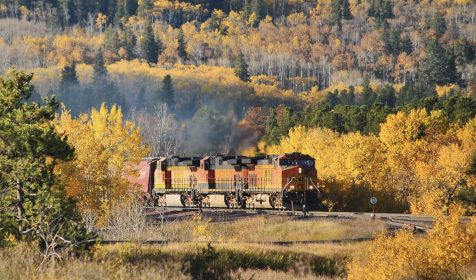 Economic Impact
 Three Reasons to Love America’s Freight Trains
Washington, D.C. — The allure of railroading in America is undeniable. It’s an intrinsic part of our nation’s history and identity—steel wheels on steel rail…

44 percent
decrease
in rail rates on average from 1981 to today.
That means the average rail customer today can ship significantly more freight for about the same price they paid 40 years ago.
State Director
Washington
Nate Kaplan
State DirectorWith a decade of experience working in the rail industry, Nate covers the Western United States and parts of New England for GoRail. His background in local, state, and federal government makes him an effective transportation and public policy leader.
Featured Rail Supply Companies







Stay informed with The Spur, GoRail's monthly newsletter, covering rail news, grants, policy updates, and stories from communities nationwide.