

Durand, MI — There are many places to tell America’s railroad story. Ours begins at a crossroads in Michigan, where generations of people, goods and opportunity have traveled through Durand.
At Durand Union Station, home to the Michigan Railroad History Museum, that story surrounds us. It lives in the photographs, artifacts and records we preserve, and it continues in the trains passing outside. From this vantage point, we see how the work of one railroad community connects to the life of an entire nation.
That perspective carries special meaning as America250 commemorates our country’s 250th anniversary in 2026 and American freight rail approaches its 200th birthday in 2027. The railroad bicentennial traces to the chartering of the Baltimore & Ohio Railroad on February 28, 1827, a defining milestone in American commercial railroading.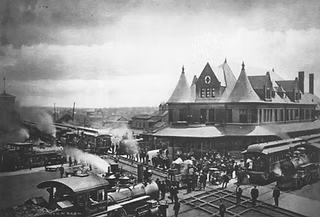
Together, these anniversaries offer an opportunity to explore how a growing nation became connected—and how freight rail continues to shape what comes next.
America’s development depended on the ability to move what its people grew, harvested and manufactured. Railroads opened access to distant markets, supported industrial growth and helped communities build livelihoods around connections that extended far beyond their borders.
Here in Michigan, those connections helped shape the state’s identity. Railroads moved lumber from forests, supported mining and agriculture, and served expanding manufacturing centers. As automobile production grew, rail helped connect Michigan’s factories with markets across the country. Our state’s railroad history reveals how closely transportation and economic opportunity developed together.
Durand offers a local window into that national transformation. Completed in 1903 for the Grand Trunk Railway System and the Ann Arbor Railroad, Durand Union Station served a town whose growth was inseparable from the railroad. The depot’s scale and craftsmanship reflect the importance of the activity surrounding it.
But the meaning of this place extends beyond its architecture. It rests in the railroad workers who kept traffic moving, the families who built lives here, and the businesses whose fortunes depended on reaching customers elsewhere. Their experiences help us understand the human effort behind a national transportation network.
That is why preservation matters. A timetable reveals the coordination required to connect communities. A tool speaks to the skill of the person who used it. A photograph places faces within the larger history of American industry. At our museum, these objects help bring a national story down to a scale people can recognize: a job, a family, a hometown.
They also give us a starting point for understanding freight rail today.
The cargo and technology have changed over time, but the need for reliable connections remains. Manufacturers need materials. Farmers need access to markets. Communities depend on goods arriving where they are needed. According to the Michigan Department of Transportation, rail carries about 17 percent of Michigan’s freight tonnage and 21 percent of its freight by value.
Behind those figures are connections between Michigan businesses and the wider economy. A freight train passing through a community may link production in one state with a customer in another. What appears to be a local movement is part of a much larger exchange.
That ability to move goods efficiently will remain important as the nation looks ahead. Railroads are, on average, four times more fuel efficient than trucks, and one train can carry the freight of several hundred trucks. These advantages help reduce emissions and highway congestion while supporting commerce.
The next chapter will also depend on continued investment in infrastructure, people and technology. Railroads are using equipment sensors, advanced inspection tools and data analysis to identify potential problems and improve operations. These developments in rail technology continue a long history of adapting to new demands.
For us, connecting visitors with that future is part of preserving the past. An encounter with railroad history can spark an interest in engineering, skilled trades, transportation or the workings of a local economy. It can also help people recognize the importance of infrastructure they see every day.
As America marks 250 years and freight rail approaches 200, we invite visitors to explore that connection at Durand Union Station. The history preserved here belongs to Michigan, and its significance reaches across America.
From our crossroads, we can see a nation built through connections—and freight rail still helping to carry it forward.