
Boise, ID — For 200 years, railroads have carried almost every kind of cargo imaginable. The industry often mirrors the economic and social patterns of any given generation. So it should be no surprise that one of railroading’s most peculiar cargoes and stories comes from the Cold War in an isolated part of Idaho.
A Cold War Locomotive Unlike Any Other
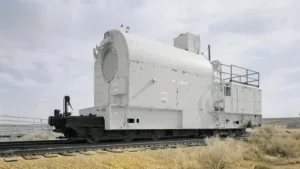
In 1954, General Electric built a specialized diesel locomotive for what is now Idaho National Laboratory. The locomotive was part of the federal government’s Aircraft Nuclear Propulsion program, one of the many wild Cold War-era experiments. This program sought to explore whether nuclear energy could be used to power long-range military aircraft. At the sprawling Idaho test site, the locomotive moved reactor and engine assemblies between testing and examination facilities.
It looked unlike almost anything else on rails. Despite being only about 45 feet long and producing roughly 400 horsepower, the locomotive weighed approximately 215 tons. Much of that weight came from extensive shielding surrounding the crew compartment, including lead and water designed to protect operators while moving highly radioactive equipment. The site even employed an unusual four-rail track arrangement to accommodate the massive experimental assemblies.
Rail’s Long Role in Nuclear Transportation
While Idaho’s shielded locomotive was extraordinary, the connection between railroads and the nuclear industry is not.
Rail has long played an important role in safely transporting radioactive materials, including spent nuclear fuel. Today, that work involves some of the most sophisticated transportation equipment in the world. In 2023, the U.S. Department of Energy completed a 1,680-mile round-trip test between Pueblo, Colorado, and Scoville, Idaho, of its new Atlas railcar system. Atlas is a 12-axle railcar designed to carry extremely heavy containers of spent nuclear fuel and high-level radioactive waste. Its accompanying train system includes buffer cars and a specially designed Rail Escort Vehicle for security personnel.
In 2024, the Association of American Railroads certified Atlas for operation on the nation’s major freight railroads.
Layers of Safety and Security
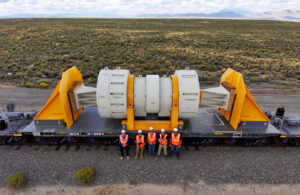
Those shipments are governed by extensive layers of safety and security. Nuclear Regulatory Commission (NRC) requirements address everything from container design and inspections to communications, routing and security procedures. Spent-fuel transportation containers are engineered to withstand severe accident conditions. The NRC reports that thousands of commercial spent-fuel shipments have moved across the United States during the past four decades without a radiological release to the environment or harm to the public.
That performance is part of a much broader freight rail safety story. America’s freight railroads move chemicals, fuels, fertilizers and other hazardous materials essential to the economy every day. More than 99.99 percent of hazardous-material shipments by rail reach their destination without a release caused by a train accident, while the hazmat accident rate per carload has declined approximately 80 percent since 2005.
From Cold War Relic to Sensor-Equipped Railcar
Today, Idaho’s “nuke train” stands as a relic of a bygone era. One can still visit it at the EBR-1 Atomic Museum outside of Arco, ID. From a heavily shielded Cold War locomotive crawling across the Idaho desert to today’s sensor-equipped Atlas railcar, nuclear transportation demonstrates one of freight rail’s fundamental strengths which is the ability to move heavy, complex and sensitive cargo safely over long distances.
Most Americans may never see one of these specialized shipments. But behind the scenes, freight rail continues to perform some of the nation’s most demanding transportation jobs, supported by engineering, training, regulation and an extraordinary commitment to safety.